










Ballyshear Links, the Lido-inspired, Gil Hanse-designed centerpiece of the new Ban Rakat Club, has formally commemorated its low-slung modernist clubhouse, completing Phase I development activities at one of the most architecturally ambitious clubs in world golf.
The 18-hole Ballyshear Links, the first Asian project ever undertaken by Hanse Golf Design, was conceived as an homage to The Lido Golf Club, an almost mythic layout from early American course architecture pioneers Charles Blair Macdonald and Seth Raynor. The original Lido opened in 1917 on featureless seaside property outside New York City, and closed quietly and without ceremony during World War II.
In between, however, the Lido course was considered the equal of any on Earth. “It is the holy grail for the ‘created’ golf course, the ultimate manifestation of what can be done with enough creativity, money, and sand,” said Hanse.
“The fact that it no longer exists makes it more romantic in nature and inspires all of us to elevate it in the pantheon of golf course architecture.”

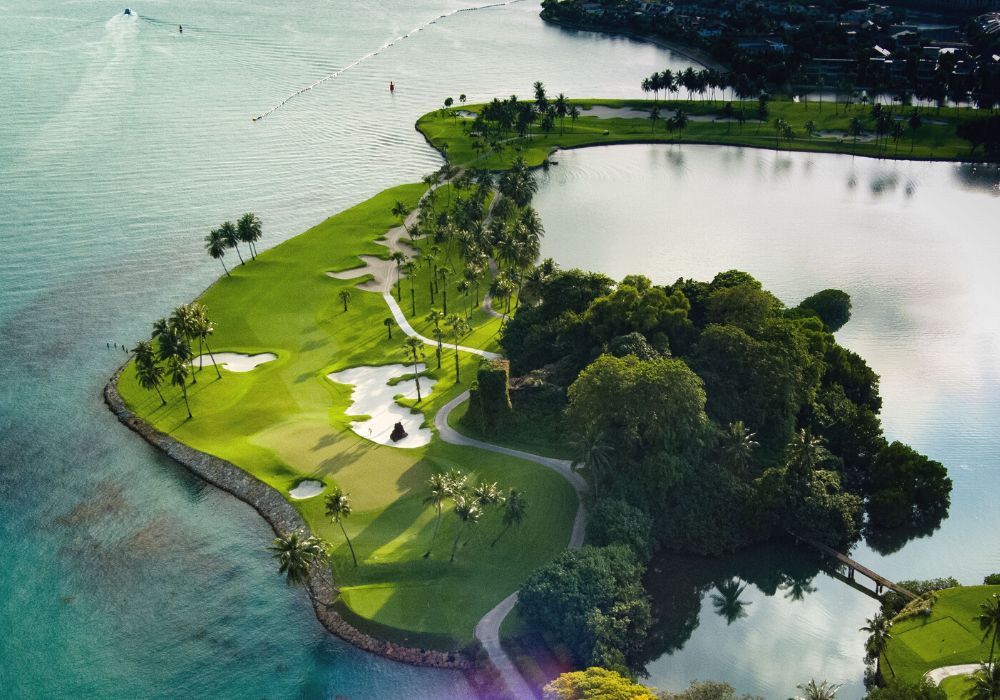
Macdonald and Raynor operated in a unique and specific way: They typically based individual hole designs on established “template” holes — the famous Alps hole at Prestwick, for example; the Redan across Scotland at North Berwick. The original Lido layout featured 18 such template holes and the Ballyshear Links routing features the identical 18 templates — each reinterpreted by Hanse and partner Jim Wagner, then adapted to the Thai landscape. But for the swapping of holes 2 and 6, Hanse and Wagner reproduced The Lido in order.
Highlights include:
• The dramatic elevations and contours at BRC’s Alps, Knoll and Redan templates (holes 10, 13 and 16), which prove all the more stunning for their canny presentation on a flat property.
• The Eden 3rd at Ballyshear, a gorgeous and completely original sand-and-scrub take on the famous 11th at the Old Course. Golfers walk right off that green and onto the oft-celebrated-but-rarely-attempted Channel hole, with its peninsular/split fairway.
• The Short hole at 14, where, on the putting surface, Hanse and Wagner beautifully rendered one of the most dramatic-yet-functional “thumbprints” anywhere.
• The epic finish where, as at the original Lido, the Redan 16th is followed by a bunker-strewn, 600-yard par-5 (Long) and a closing par-4 first dreamed up by Dr. Alister MacKenzie, whose design for the original Lido 18th won a design contest in the English magazine, Country Life.

“I remember reading about the Lido competition that MacKenzie won,” Hanse says. “I was doing some research at Cornell [University] and they had a great collection of original editions of this magazine. After seeing the competition, I did more research on the Lido… We also had the great fortune to work with Macdonald and Raynor biographer George Bahto on several projects. He was always going on about the Lido. After his passing, George’s family allowed us to use his Lido file to help us in our design for Ballyshear. It proved invaluable!”
The founders of Ban Rakat Club were all members at Kiarti Thanee Country Club, a successful private club with an ordinary, dead-flat, 25-year-old golf course whose chief attribute was location — just 35 minutes from centre city and 20 from Suvarnhabumi International Airport. In 2017, these members approached the club development/management experts at Yokohama International, Ltd. Together with Hanse, they resolved to radically transform their property.
One result was the extraordinary new clubhouse, designed by Kengo Kuma & Associates whose may be the most high-profile design firm ever to undertake a clubhouse design. Its reputation and signature projects are normally expansive and high profile: the new National Stadium in Tokyo, the Louis Vuitton Moet Hennessy Group's Japanese headquarters. By contrast, Kuma’s clubhouse at Ban Rakat Club is splendidly warm and intimate.
The Ballyshear Links itself, named for C.B. Macdonald’s ancestral estate on Long Island, is the other result of this redevelopment project. The new course and clubhouse were both fully completed earlier in 2022, following an unusually painstaking construction process.

“It’s incredible to think back — through two and a half years of Covid — to when this project began,” Wagner says. “Just reflecting on what this property was when we showed up: a dilapidated, perfectly flat golf course. What it has become today? A total and truly remarkable transformation from a golf course, landscape, earthwork and vegetation standpoint.”
Because of Covid restrictions, neither Hanse nor Wagner has set foot in Thailand since late 2019. Rather than suspend development operations, their trusted in-house shaping unit, Caveman Construction, remained on site at Ballyshear to complete the project.
“That is completely against the philosophy that we have adopted for all of our courses,” Wagner explains. “However, we were living in strange times. Hats off to Bret Brennan, Josh McFadden, Trevor Dormer and Tanner Guyer for working tirelessly on this project, and to Shaymus Maley, Jaeger Kovich, and Robert Nelson for jumping in as well. We trusted their abilities.
“From the images, it looks like our trust has been rewarded by their great work. We are hopeful to get back over there to play some golf at the start of 2023.”